Free Shipping & 30 Day Returns
Free Shipping & 30 Day Returns
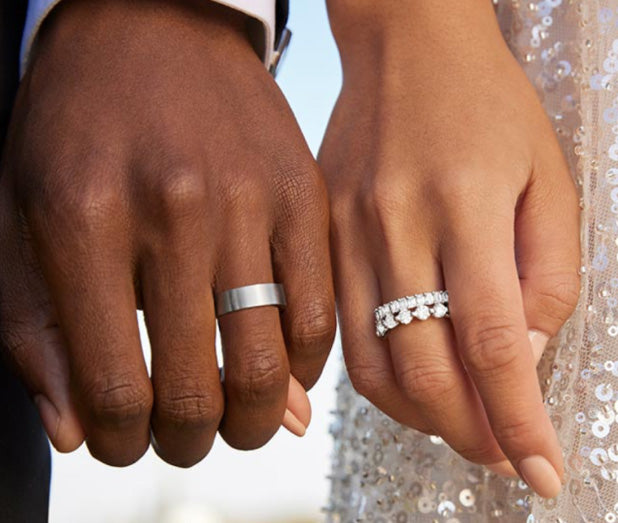
A wedding ring is worn every day for the rest of your life. The right choice feels effortless on the hand — balanced, comfortable, and quietly right in any situation.

The ring should feel easy on the hand from day one — not just on the wedding day.
A 1–2mm difference in width changes both the feel and the presence of the ring entirely.
Colour, weight, and durability all shape how the ring looks and wears over time.
If worn alongside an engagement ring, balance between the two matters as much as either ring alone.
Before thinking about styles and finishes, it helps to begin with the simplest question: how do you want the ring to feel during ordinary life? Every other decision follows from that.
A wedding ring should disappear into daily life, not draw your attention. The right profile — whether that's a softly rounded interior or a flatter court shape — makes a significant difference on the hand.
Narrower bands feel lighter and more understated. Wider bands create more presence and visual weight. Neither is better — it depends on your hand and how you want the ring to read.
A court profile is gently domed on the outside and softly curved within. A flat band has a cleaner, more contemporary edge. The difference is often felt before it is seen.
This is not a ring for a single occasion. It should feel right at the dinner table, at a desk, on the move, and in the moments between.
If the wedding ring will sit beside an engagement ring, the relationship between the two shapes the whole look. The aim is balance, not uniformity.
Some engagement rings sit naturally beside a simple straight band. Others are better served by a gently curved or shaped wedding ring that follows the contour of the setting rather than pushing against it.
Matching metals is the most common approach, though it is not a rule. A subtle contrast in tone can feel considered and intentional when done well.
Proportion is the real concern. A beautiful engagement ring can be overwhelmed by the wrong band beside it, or made to feel calmer and more complete by the right one.

Metal changes the entire character of a wedding ring. It affects tone, weight, durability, and how the ring ages over time. The simplest guide: look at what you already wear every day.
Most decisions come down to how much detail you want, and how the ring should sit beside the rest of your jewellery. Here is a brief guide to the most common styles.
Width affects how the ring feels on the hand and how much presence it has visually. It is worth considering carefully — especially if the ring will be worn alongside an engagement ring.
Finer hands often suit narrower widths between 1.5mm and 2.5mm. Wider hands tend to carry a 3mm or 4mm band with more confidence. These are starting points, not rules.
If worn beside an engagement ring, the wedding band is usually slightly narrower, which keeps the engagement ring as the primary piece.
If worn alone, a wider band can feel more substantial and anchored on the hand — which some people prefer.
| Width | Character |
|---|---|
| 1.5–2mm | Very fine and delicate. Especially elegant when stacked beside an engagement ring. |
| 2.5–3mm | The classic choice. Noticeable without being heavy — suits most hands and styles. |
| 3.5–4mm | More substantial. Often chosen when the ring is worn on its own, or as the primary piece. |
| 5mm+ | A stronger presence. Common in men's wedding rings and sometimes chosen for a bolder look. |
A wedding ring becomes part of everyday life with remarkable speed. Within weeks, most people stop noticing it — and that is, in many ways, the measure of the right choice.
Because of that, many people find themselves drawn to something slightly calmer than they anticipated. Not plainer — just less effortful.
That is not a compromise. It is often the more refined decision. The rings that wear best over a lifetime tend to be the ones that feel inevitable, rather than impressive.
Browse by style, metal, or approach — every ring at joolme is made to order, set by hand, and designed to be worn every day.
Every ring is crafted for you. That means correct sizing from the start, the metal you want, and a finish suited to how you plan to wear it.
We focus on rings that feel right well beyond the wedding itself — comfortable in real life, not just on the day.
Choosing a wedding ring should feel calm and considered. Our team is here to help — on WhatsApp, by phone, or via a virtual consultation.
Free resizing within 60 days of purchase. Lifetime warranty. Service and support that continues long after the ring leaves us.
Start with how you want it to feel, then consider width, metal, and whether it will be worn beside an engagement ring. Style follows naturally from those decisions.
Not exactly — but it should feel balanced alongside it. The same metal is the most common choice, though a subtle contrast can work well when done deliberately.
There is no single answer. Platinum is the most durable and naturally white. Yellow gold is the warmest and most classic. White gold is bright and versatile. The best choice is the one that suits how you wear jewellery day to day.
For most women, 2–3mm is the most comfortable range. For men, 4–6mm is typical. If worn beside an engagement ring, slightly narrower usually works better so the two do not compete.
Platinum is harder and does not require rhodium plating, which makes it lower maintenance over time. Gold offers more warmth and a wider range of tones. Neither is objectively better — the right choice depends on your preferences and how you intend to wear the ring.
Yes — this is one of the most common questions we help with. We can advise on width, profile, and metal to find something that feels balanced and natural alongside your engagement ring. Chat to us on WhatsApp or book a consultation.
Browse rings designed to be worn every day — made to order, crafted by hand, and built to last.


